Zero Dollars, Real Glory: How Free-to-Play Esports Opened the Door for Every American Competitor
Let me paint you a picture. It's 2012. You want to get serious about competitive gaming. You need to buy the game — probably $60. Then the expansion — another $40. Maybe a specific edition with the maps or characters everyone else is using. By the time you've got a remotely level playing field, you're out over a hundred bucks before you've played a single ranked match.
Now compare that to today. You want to grind ranked in Valorant? Download it. Free. Dota 2? Free. Counter-Strike 2? Free. The entire competitive ecosystem — the ranked ladders, the community tournaments, the path toward a professional career — is sitting there waiting for you, and it costs exactly nothing to walk through the door.
This isn't a small thing. This is one of the most significant structural shifts in gaming culture of the past decade, and it doesn't get nearly enough credit.
The $0 Entry Fee Changes Everything
Here's the uncomfortable truth about competitive gaming before free-to-play dominated the scene: it had a class problem. Not an intentional one, but a real one. When the cost of participation is $60 or more per title, you've already filtered out a significant chunk of potential players — particularly younger gamers, players in lower-income households, and anyone living in parts of the country where spending money on games feels like a luxury.
That filter doesn't just affect who plays. It affects who gets good. It affects who grinds ranked for thousands of hours. It affects who ends up on a pro team.
Free-to-play didn't just lower the barrier — it essentially eliminated it. When Riot Games launched Valorant in 2020 as a free download, they made a deliberate bet that the competitive community would grow faster and become more diverse if money wasn't the first obstacle. They were right. Valorant now boasts millions of active players in North America alone, and its competitive scene pulls talent from communities that traditional esports titles never reached.
Real Players, Real Stories
The most compelling argument for free-to-play's democratizing effect isn't statistical — it's personal.
Take the story of players who came up through Dota 2, a game that has been completely free since 2013. Valve's decision to release the game at no cost, with all heroes available from day one, meant that skill — raw, uncut, hours-in-the-chair skill — was the only real currency. You couldn't pay to unlock a competitive advantage. You either learned or you didn't.
That structure produced some of the most technically sophisticated players in esports history, many of whom started with nothing more than a modest PC and a broadband connection. The game's International tournament has paid out over $300 million in prize money across its history. The pipeline from free download to world-class competitor is real.
Counter-Strike 2 follows a similar arc. When Valve made the game free-to-play in 2018 (then updated it as CS2 in 2023), the already-massive competitive community exploded further. Community servers, FACEIT leagues, and third-party tournament organizers filled the gap between casual play and professional competition — all accessible to anyone with a PC capable of running the game.
These aren't isolated cases. They're a pattern.
The Cosmetic Economy Trade-Off
Let's be honest about the model, though. Free-to-play esports titles aren't charities. They make money — often enormous amounts of it — through cosmetic microtransactions. Skins, weapon wraps, character emotes, battle passes. The argument from publishers is that none of this affects competitive performance, and for the most part, that's true.
But it's worth acknowledging the tension. A player who can't afford a $10 battle pass might feel like an outsider in communities where skins signal status. The "broke gamer" experience isn't always invisible, even when the core gameplay is free.
What matters, though, is that the competitive integrity holds. In Valorant, a player with every Agent unlocked through grinding in-game currency performs identically to someone who spent $50 on cosmetics. The ranked ladder doesn't care what your gun looks like. Your opponents won't either — not when they're watching your crosshair placement.
What This Means for the Future of Esports
The downstream effects of free-to-play's dominance in competitive gaming are still unfolding, but a few trends are already clear.
First, talent pools are genuinely deeper. When millions of players can access the same game on day one without spending a dime, the sample size of potential pros increases dramatically. That's good for the quality of competition and good for the longevity of esports as a spectator product.
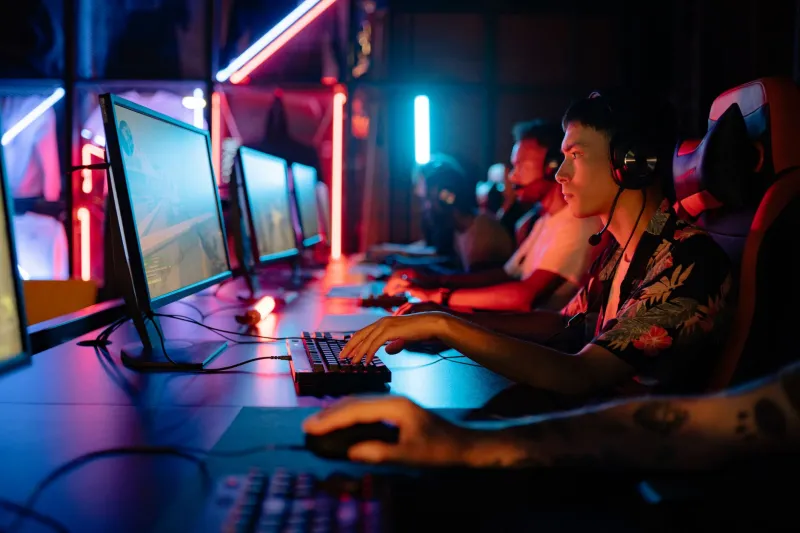
Second, community-run competition is thriving. Sites like Battlefy, Challonge, and game-specific platforms host thousands of free-to-enter or low-cost tournaments every month. For an American gamer who wants to test their skills without flying to a LAN event, the infrastructure has never been more accessible.
Third — and this is the part that excites me most — we're starting to see free-to-play competitive titles develop pipelines that didn't exist before. College esports programs are building rosters around Valorant and Rocket League. Coaches are emerging from communities that started with zero investment. Streaming careers are launching from nothing but a free game and a decent internet connection.
The Bigger Picture
At Free Games Hub, our whole mission is built on a simple belief: great gaming shouldn't require a great budget. Competitive gaming used to contradict that principle. The best titles cost money. The best players had advantages tied to spending.
Free-to-play esports has quietly dismantled that logic. Today, the gap between a kid in rural Ohio with a hand-me-down PC and a gamer in a well-funded setup in California is smaller than it's ever been — not because hardware doesn't matter, but because the game itself is no longer a financial obstacle.
That's worth celebrating. The leaderboard is open. The tournament brackets are filling up. And the only thing you need to enter is the time to get good.
Pay nothing. Compete for everything.